
Crushing Credit Card Debt in 2026: Is 0% Transfer, Personal Loan, or HELOC Quietly Cheapest for You?

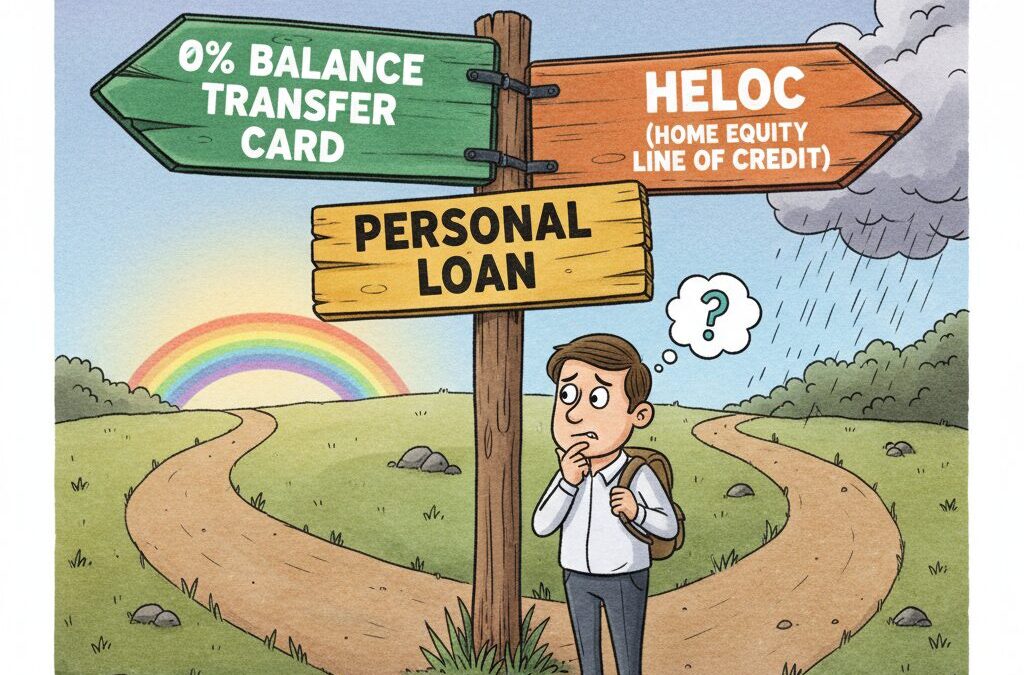
Credit card APRs pushing 25%–30% have turned everyday balances into runaway fires. You already know you should consolidate—but how? In 2026, the real money question is not “Where do I get a loan?” but “Is a 0% balance transfer card, a personal loan, or a HELOC actually cheapest for my situation?”[1][2]
This guide walks you through that decision with current 2026 rate ranges, concrete examples, and a simple decision path you can follow today.


The 2026 Landscape: What You’re Competing Against
Before you compare tools, anchor yourself against the enemy: your current card APR.
- Average credit card APR: ~21%–28% for general‑purpose cards, often higher for rewards accounts (varies by issuer, but consistently above 20% in recent data).[1]
- Average personal loan rate: ~12.5% overall, but can jump 2–3x higher for poor credit.[1]
- Typical HELOC rates: variable, often ~7.7%–8.1% for qualified borrowers, per recent industry data.[3]
Your goal is simple: move from 20%+ to the lowest effective rate that fits your life—and your risk tolerance.
Option 1: 0% Balance Transfer Cards – Best for Sprinters
0% balance transfer cards are the closest thing to an “interest off” switch—if you can clear the balance in time. These cards offer an introductory 0% APR for 12–21 months on transferred debt, often with a 3%–5% transfer fee.[1][7][9]
What They Look Like in 2026
Examples of popular 0% transfer cards (exact offers vary by issuer and credit profile):
- Citi® Diamond Preferred® Card – Commonly offers 0% intro APR on balance transfers for up to 21 months, then a variable APR often north of 20%. Typical transfer fee: 3%–5% of the amount transferred (around $300–$500 on a $10,000 move).
- Wells Fargo Reflect® Card – Frequently features one of the longer 0% intro periods (up to about 21 months) with a similar 3%–5% transfer fee range.
- Chase Slate Edge℠ – Generally offers a shorter 0% period (often around 12–18 months) but still a major player for good‑credit borrowers.
These cards are mostly available if your credit score is good to excellent (often 680–700+ for strong limits and longest promos).
Who a 0% Transfer Is Best For
- Balance size: Small to mid balances (typically under $10,000–$15,000) you can pay off in 12–21 months.
- Credit profile: Strong scores and clean history to qualify for the best 0% offers and decent limits.[1][9]
- Personality: Disciplined budgeter who will attack the debt and avoid new spending on that card.
Example: $8,000 Paid Off in 18 Months
Assume:
- Current card APR: 24%
- 0% balance transfer for 18 months; 4% transfer fee ($320).
- You pay $450/month.
You’ll clear the balance within the promo period, paying no interest, just the $320 fee. Compare that to staying put at 24% APR, where you’d likely pay well over $1,000 in interest over that period. Even with the fee, the transfer wins decisively.
Risks and Gotchas
- After promo, APR can jump back to 20%+—dangerous if you don’t finish in time.[1]
- Transfer fees quietly raise your effective rate.
- Credit limits may not cover all your debt, leaving stragglers on high‑APR cards.[1]
Option 2: Personal Loan – Best for Structure and Predictability
Personal loans replace your revolving card debt with a fixed‑rate installment loan—steady payments for 2–7 years, with a guaranteed payoff date.[1][3][6]
What Personal Loans Look Like in 2026
Typical market snapshot:
- Average APR: around 12.5%, with top‑tier borrowers seeing single digits and weaker profiles seeing 20%–30%+.[1][3]
- Amounts: ~$1,000 to $100,000 from many major lenders.[2][3]
- Terms: Usually 2–7 years, sometimes up to 10.[2][3]
Representative lenders and ranges (your offer will differ):
- SoFi Personal Loan – Often advertises rates starting around the high‑single digits for excellent credit, offering up to $100,000 with no origination fee for qualified borrowers.[4][6]
- Discover® Personal Loans – Commonly in the high‑single to mid‑teens APR range for good credit, loans up to ~$40,000, with no origination fee but a late fee if you miss.
- LightStream (Truist) – Frequently markets very competitive low rates for excellent credit and larger balances, often best for $25,000+ loans.
Example: $20,000 Over 5 Years
Assume you consolidate $20,000 at 12% APR in a 5‑year personal loan:

- Monthly payment: ~${444}–$445.
- Total interest: roughly $6,600.
- Total repaid: ~${26,600}.
Compare that to carrying $20,000 on a 24% APR card while making similar payments; you could easily pay over $10,000 in interest and take longer, because the balance can creep back up.
Who a Personal Loan Is Best For
- Balance size: Mid to large balances (e.g., $10,000–$75,000) where 12–21 months is too aggressive.
- Credit profile: Fair to excellent (580+ to qualify at many lenders; 660+ for stronger rates).[2][3]
- Needs: You want one predictable payment and a hard payoff date, with no home on the line.
Pros vs. HELOC
- No collateral required; your home is safe from foreclosure risk.[2][3][5]
- Fixed rate = stable payment; no surprise jumps if interest rates rise.[2][3]
- Fast funding (often 1–3 days) and simpler underwriting than a home‑equity product.[6]
Option 3: HELOC – Best for Homeowners Chasing Rock‑Bottom Rates
A home equity line of credit (HELOC) lets you borrow against your home’s equity at a typically lower interest rate than personal loans or credit cards.[1][2][3]
2026 HELOC Snapshot
Current patterns from major banks and credit unions:
- Typical variable APR: ~7.7%–8.1% for well‑qualified borrowers; often 2–5% lower than equivalent personal loan offers.[2][3]
- Credit required: Often 620+ minimum, with 680+ for the best rates.[2]
- Limits: Usually up to 80%–85% of home equity; common ranges $25,000–$500,000+.[2][3]
- Fees: Closing costs ~2%–5% of the line; some lenders also charge annual fees or require minimum draws.[1][3]
Example: $40,000 Consolidation – HELOC vs Personal Loan
Using a recent comparison:[2]
- HELOC at 8.0% (5 years):
– Monthly payment: ~$811
– Total interest: ~$8,660
– Total repaid: ~$48,660 - Personal loan at 12.0% (5 years):
– Monthly payment: ~$889
– Total interest: ~$13,340
– Total repaid: ~$53,340 - HELOC savings: About $4,680 over 5 years on the same $40,000.[2]
That’s the core HELOC advantage: for larger balances, a few percent difference in rate can mean thousands saved.
Who a HELOC Is Best For
- Homeowners with substantial equity and stable income.
- Large balances (often $25,000+), where rate savings outweigh closing costs.[2][3]
- Borrowers comfortable with variable rates and the risk of using their home as collateral.[1][3]
Key Risks
- Your home secures the debt—fall behind and you could face foreclosure.[1][2][3]
- Variable rates mean payments can rise over time if broader rates go up.[1][3]
- Long terms (20–30 years total) can make interest add up dramatically if you pay slowly.[3]

Decision Tree: Which Path Is Actually Cheapest for You?
Use this quick logic path as a starting point:
Step 1: Can You Realistically Pay It Off in 12–21 Months?
- Yes, and you have good credit (680+): A 0% balance transfer card is often cheapest despite the fee—if you stick to the plan.[1][7][9]
- No, or your credit is weaker: Move to Step 2.
Step 2: Are You a Homeowner with Solid Equity?
- Yes, and you’re comfortable using your home as collateral:
– For balances $25,000+ and multi‑year payoff, a HELOC usually has the lowest rate and total interest cost.[2][3]
– Run the numbers including closing costs; if you’ll keep the balance for several years, HELOC often wins. - No, or you prefer not to risk your home: Move to a personal loan.
Step 3: Personal Loan vs Doing Nothing
- Compare your current weighted APR (e.g., 24%) with realistic personal loan offers (say 12%–20%).[1][3]
- If the loan rate is significantly lower and you commit to not re‑using the cards, a personal loan often cuts both monthly payment stress and total interest.
Action Plan: What to Do in the Next 48 Hours
1. Map Your Debt and APRs
- List all balances, APRs, and minimum payments.
- Highlight any cards above ~20% APR—that’s where consolidation usually pays off fastest.
2. Do a No‑Impact Rate Check
- Use pre‑qualification tools from lenders like SoFi, Discover, or LightStream to see estimated personal loan offers without a hard credit pull.[4][6]
- Check pre‑approval tools from major card issuers (Citi, Chase, Wells Fargo) for 0% balance transfer offers if your credit is strong.
- If you’re a homeowner, get HELOC quotes from your primary bank or local credit union and compare total costs, not just headline rate.[2][3][8]
3. Run the Math on 2–3 Scenarios
For each option that seems possible, calculate:
- Monthly payment.
- Total interest + fees over the payoff period.
- Worst‑case APR after promo (for cards) or potential rate hikes (for HELOCs).
Online calculators from lenders and personal finance sites make this quick and visual.[1][2][7][9]
4. Lock In a Plan and “Debt‑Proof” It
- Once you consolidate, freeze or close old cards you don’t need, or at least remove them from digital wallets to avoid re‑loading debt.
- Set up automatic payments for at least the target amount required to clear the debt within your chosen timeline.
- Put a calendar reminder 60 days before any 0% promo ends or HELOC rate adjustment windows.

Which Tool Wins in 2026? It Depends on Your “Type”
If you want a quick rule of thumb for today’s environment:

- “Sprinter” with strong credit and <$10k–$15k: 0% balance transfer is usually cheapest if you’re ultra‑disciplined.
- “Planner” with mid‑to‑large debt and no home equity: A fixed‑rate personal loan gives structure, lower risk, and a clear end date.
- “Homeowner optimizer” with large balances (>$25k): A HELOC often provides the lowest rate, but comes with home‑collateral risk and variable payments.[1][2][3]
The biggest financial win usually comes not from choosing the perfect product, but from committing to one clear payoff path and relentlessly sticking to it.

Unlock Full Article
Watch a quick video to get instant access.

Social Media