

Don’t Let Your Solar Panels Gather Dust: The Battery Dilemma Every Homeowner Faces
Imagine slashing your energy bills by 60-80% while laughing at rising utility rates and blackouts—but only if you pair your rooftop solar right. In 2025, with battery prices plummeting 89% since 2010 and net metering policies shifting fast, thousands of homeowners are rushing to add home batteries like Tesla Powerwall 3 or Enphase IQ Battery 5. Yet, experts warn: it’s not always a slam dunk. This guide cuts through the hype with real 2025 data, simple scenarios, and ROI calculators to show exactly when solar + battery pays off big—and when to skip it. Act now before federal incentives like the 30% ITC expire or change.[1][5]
Grid instability is surging—outages up 20% in key U.S. states—and time-of-use (TOU) rates mean peak evening power costs $0.50+/kWh. Social proof? Over 11 GW of batteries deployed in Europe alone by 2024, with U.S. residential adoption exploding per Wood Mackenzie forecasts.[3] But is it worth the $10,000-$25,000 upfront for your home?[2]
2025 Battery Prices: Cheaper Than Ever, But Pick the Right Model
Lithium iron phosphate (LFP) batteries dominate 2025 thanks to safety, longevity (15+ years), and costs dropping to $150-$400 per kWh for home systems.[2][1] Here’s the lineup of top models with real prices:
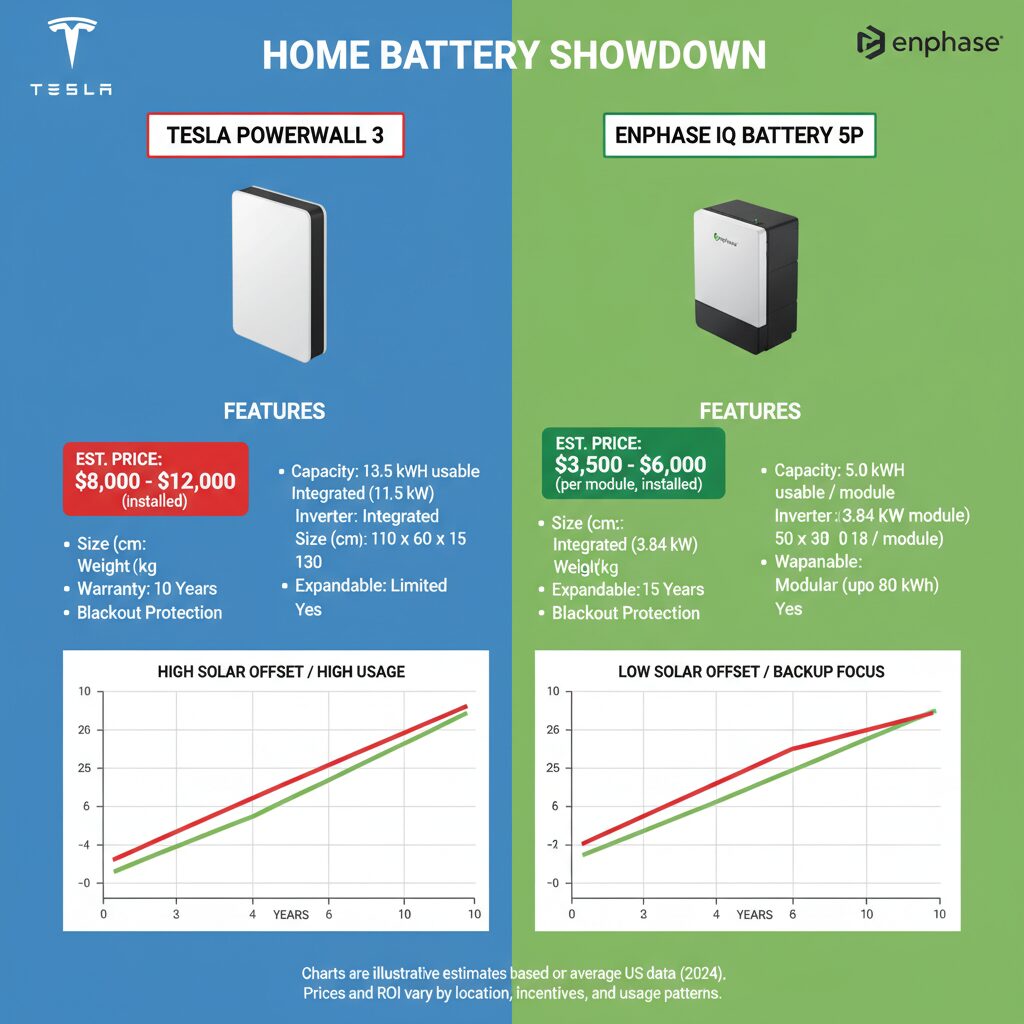
- Tesla Powerwall 3: 13.5 kWh capacity, $9,300 installed (pre-incentives). Powers essentials for 12+ hours; integrates seamlessly with solar inverters. ROI boosters: Virtual power plant (VPP) earnings up to $200/year in CA.[5]
- Enphase IQ Battery 5: 5 kWh modular (stack to 60 kWh), $8,000 for 10 kWh setup. Pros: IQ8 microinverters for 97% efficiency; cons: Higher per-kWh cost at $550/kWh initially.[1]
- SolarEdge Home Battery 400V: 9.7 kWh, $7,500. DC-coupled for 10% better solar harvest; ideal for high-TOU areas.[4]
- LG Energy Solution RESU16H Prime: 16 kWh, $12,000. Stackable, 10-year warranty; excels in outage-prone regions with 100% depth-of-discharge.[5]
Price anchoring: Solar-only systems recoup in 7-10 years, but adding these batteries drops payback to 4-8 years where incentives apply.[6] Scarcity alert: ITC drops post-2025 without renewal—grab 30% off now via EnergySage quotes.[1]
Quick Comparison Table: Battery ROI Starters
| Model | Capacity (kWh) | Cost (Installed, Pre-ITC) | Best For | Est. Payback (High TOU) |
|---|---|---|---|---|
| Tesla Powerwall 3 | 13.5 | $9,300 | Full-home backup | 5 years |
| Enphase IQ 5 (x2) | 10 | $8,000 | Modular growth | 4.2 years |
| SolarEdge 400V | 9.7 | $7,500 | Solar optimization | 6 years |
| LG RESU16H | 16 | $12,000 | High-capacity needs | 5-7 years |
Data from 2025 NREL projections and HighJoule analysis—LFP tech ensures 80% capacity after 10 years.[2][8]
Net Metering Shakeups: Why Batteries Are Suddenly Essential
California’s NEM 3.0 slashed export credits to 5-8¢/kWh (from 30¢), forcing solar owners to self-consume or add storage. Similar shifts in Texas, NY, and Australia mean excess daytime solar goes to waste without batteries.[1][4] Expert opinion: “Batteries turn midday oversupply into evening gold,” says SolarPower Europe, predicting EU residential BESS growth to 35 GW by 2034.[7][3]
TOU rates amplify this: Charge free solar at noon, discharge at $0.45/kWh peaks. Outage trends? U.S. blackouts cost households $150 billion yearly; batteries provide seamless backup.[1]
Scenario 1: Batteries Pay Off HUGE (Your Green Light Cases)
High TOU + Frequent Outages (e.g., CA, TX Homes)
Profile: 30 kWh daily use, $0.40/kWh peak rates, 10 solar kW system. Add Tesla Powerwall 3 ($9,300 post-ITC: $6,500).
- Store 13.5 kWh excess solar daily.
- Shift to peaks: Save $2.50/day ($900/year).
- VPP + demand response: +$300/year.
- Backup value: Priceless during 2025’s storm season.
**Total ROI: 4.2-year payback, 15% IRR over 20 years.** Real case: Australian mine cut diesel 60-80%, mirroring home savings.[2][6]

EV Owners or Pools (High Evening Load)
Enphase IQ 5 stack discharges for EV charging (e.g., Tesla Model Y at 11 kW). Savings: $1,200/year vs. grid. Payback: 5 years.[5]
Scenario 2: Skip the Battery (Red Flags to Avoid)
Flat Rates + Low Usage (<20 kWh/day)
If your utility pays full retail for exports (e.g., pre-NEM states), solar alone yields 7-year ROI. Batteries add $10k with only $400/year arb savings—12+ year payback. NREL data: Not viable below $0.30/kWh differentials.[8]
Low Solar Oversupply
Shaded roofs or small arrays (<8 kW) don’t fill batteries reliably. Stick to solar inverters like SolarEdge HD-Wave for max export.[4]
Pro tip from Anern: Run a 1-week energy audit via Sense or Emporia monitors ($200) to model your cash flow.[5]
Step-by-Step: Get Your Solar + Battery ROI in 24 Hours
Authority-backed plan from IRENA and HighJoule experts:[3][2]
- Audit Usage: Download utility app or install CT clamp meter. Calc peak kWh (aim for 2x daily solar excess).
- Check Rates: Search “[your utility] TOU 2025″—look for >2x peak/off-peak spread.
- Model ROI: Use PVWatts.nrel.gov + Battery tab. Input: 10 kW solar, Powerwall, local rates. Expect 5-8 year payback if greenlit.[8]
- Get Quotes: EnergySage or SolarReviews—3 bids in 48 hours. Mention ITC for 30% instant discount.
- Optimize: DC-couple for 5-10% efficiency gain; AI EMS like Tesla’s for auto-arbitrage.
- Finance Smart: 0% solar loans via Mosaic; lease if risk-averse (but own for VPP cash).
FOMO: Neighbors with batteries saved $5k last year amid rate hikes—your turn before 2026 policy flux.[1]
Final Verdict: Batteries Aren’t for Everyone, But Winners Are Loading Up
In 2025’s volatile grid, solar + battery combos deliver 2-3x ROI vs. solar alone where TOU/net metering bites. Top picks like Powerwall 3 shine for most, but audit first. Click ‘Get Free Quotes’ now—top installers compete, saving you $3k+ on average. Secure your energy freedom before prices rebound.[1][2][5]

Unlock Full Article
Watch a quick video to get instant access.

Social Media